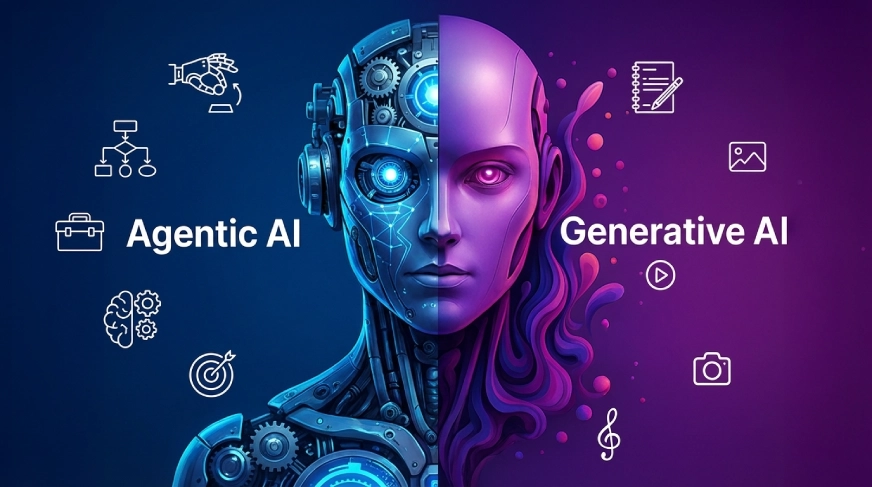
The last two years have been defined by one word: Generative AI. Tools like ChatGPT, Gemini, and Claude turned AI from a technical term into a household name.
Howeverwe are now entering the next phase of AI evolution. The conversation is moving away from AI build it to AI that actions. Gone are the days of guiding AI as a tutor, every step of the way. This is the era of AI Agent.
Although they share the same DNA, the difference between Generative AI and Agentic AI is, as you will soon realize, the difference between a calculator and a computer.
What is Generative AI?
Generative AI is a form of artificial intelligence designed create new content by analyzing existing data.
These systems learn patterns in large datasets (through training) and use that knowledge to generate completely new results that follow similar patterns.
Those results can include:
Generative AI answers questions like:
- Write a paragraph about this topic.
- Create an image from this description.
- Create code that solves this problem.
Tools like ChatGPT, Nano Banana, Midjourney, and DALL-E are all powered by generative AI models. They can write stories, create artwork, summarize texts, generate codes, and act out conversations.
Read more: AI vs Generative AI
What is Agent AI?
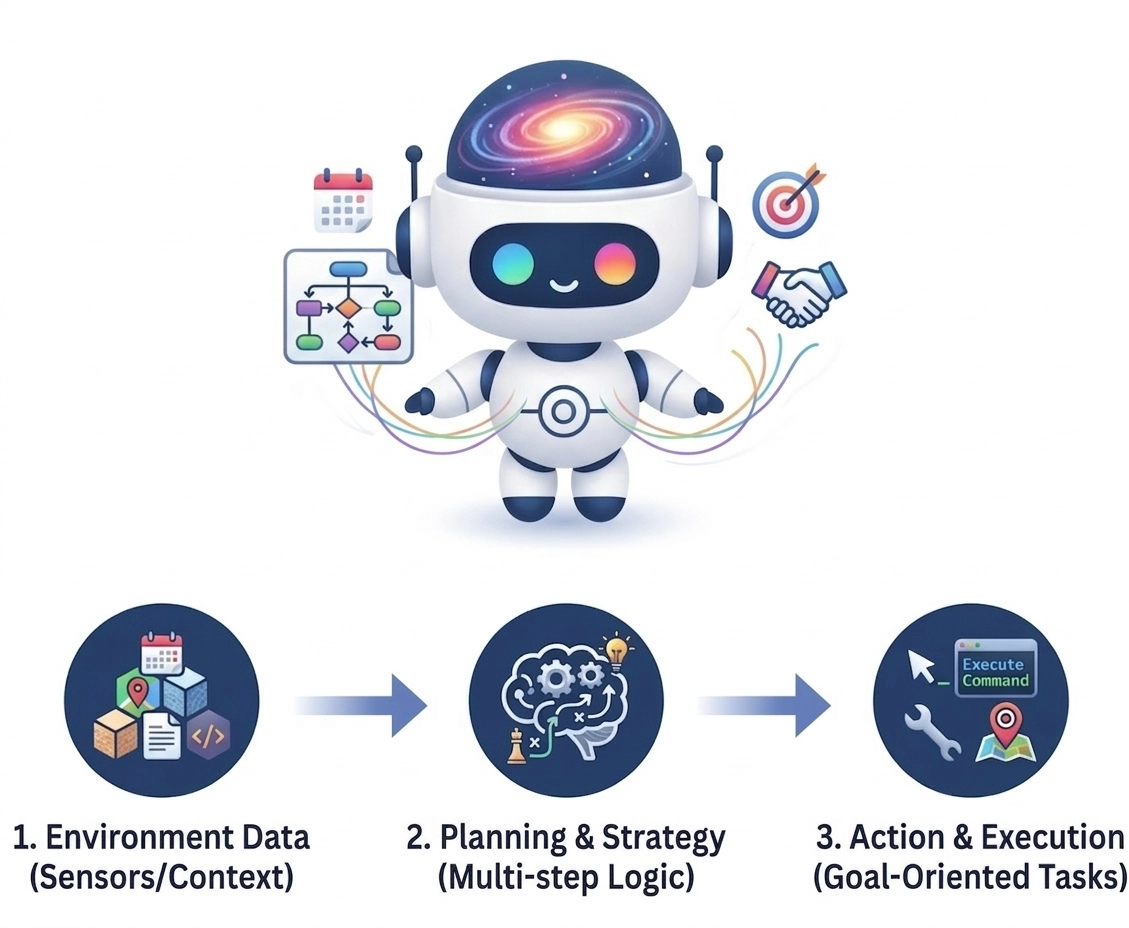
Agentic AI is a type of artificial intelligence designed take action and achieve goals automatically.
At the heart of Agentic AI systems is something called An AI agent. An AI agent is a system that can perceive information, think about a goal, and take action using tools or software to achieve that goal.
Instead of just generating an immediate response, an AI agent can plan steps, interact with external systems, and adjust its actions based on new information.
Agent AI answers questions like:
- Find the best flight options and book a ticket.
- Research the company and identify the right person to contact.
- Monitor market prices and send alerts when conditions change.
To accomplish these tasks, the agent typically performs actions such as:
- to search the web
- using APIs
- interaction with software tools
Agent systems are often built on top of generative AI models, which act as the reasoning engine while the agent handles planning, tool use, and execution.
Frameworks like AutoGPT, CrewAI, LangGraph, and AutoGen allow developers to build AI agents that can complete complex workflows with minimal human supervision.
How does Agent AI work?
Agent AI systems focus on achieving goals by thinking, taking action, and continuously adapting based on feedback. Unlike traditional AI systems that tend to follow pre-defined decision trees, Agentic AI works through an iterative thought process often called React (Reason + Action) frame.
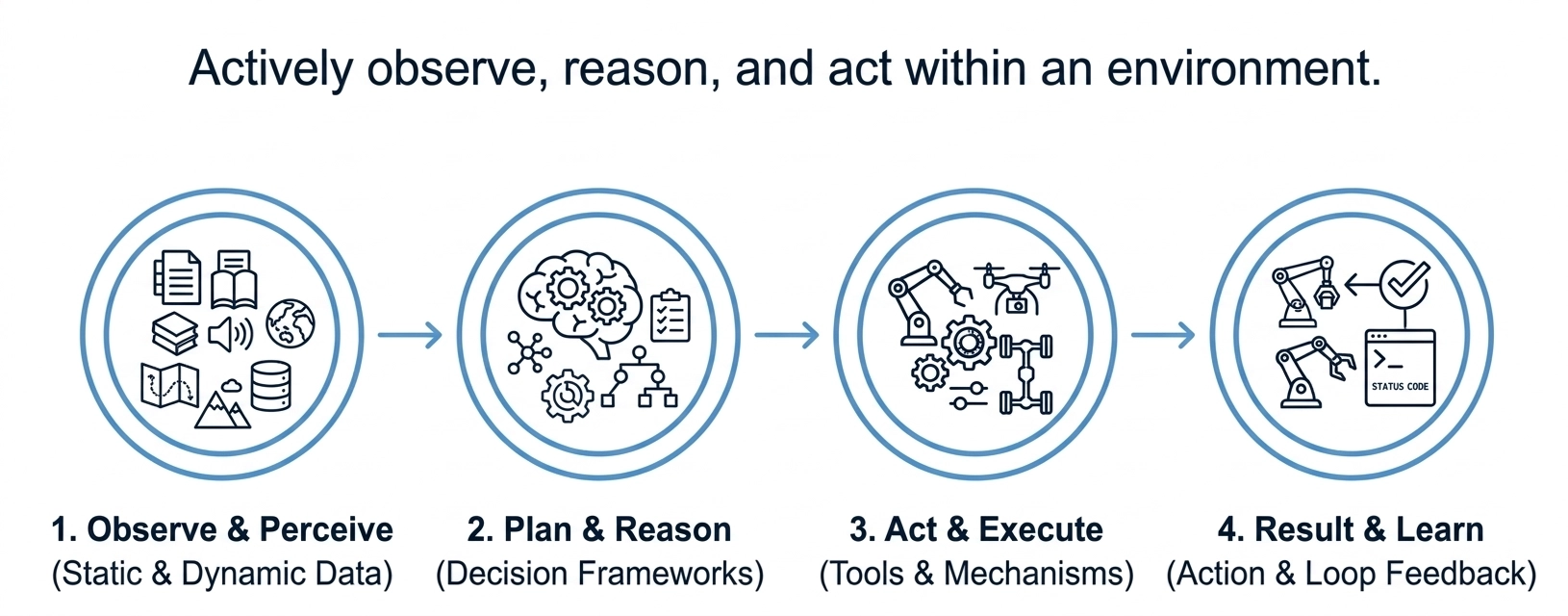
A typical application looks like this:
- Note: An agent begins by understanding the purpose or task it needs to accomplish. This can be anything from answering a difficult question to planning a series of actions to complete a task.
- Reason: The agent analyzes the goal and decides what information or actions are needed next. Example: “I have to check the weather before I lift the blanket.”
- Do: Based on its reasoning, the agent takes action using an external tool, API, or data source. Example: Calling a weather API like OpenWeather to get the current forecast.
- Repeat: Using this new information, the agent updates its plan and decides if further action is required. The cycle then repeats until the task is completed or a satisfactory result is achieved.
The main idea behind Agentic AI is that the system proceeds cyclically through thought, action, and observationallowing it to solve problems dynamically rather than simply generating a single answer.
How does Generative AI work?
Generative AI models focus on it creating new content to replace the patterns they have learned. They are trained to learn the basic patterns and structures of large datasets so that they can produce output that resembles real data.
Instead of relying on datasets with labeled results, generative models are often trained on large collections of raw data such as text, images, audio, or code. By analyzing this data, the model learns how different parts of the data relate to each other and what patterns tend to occur.
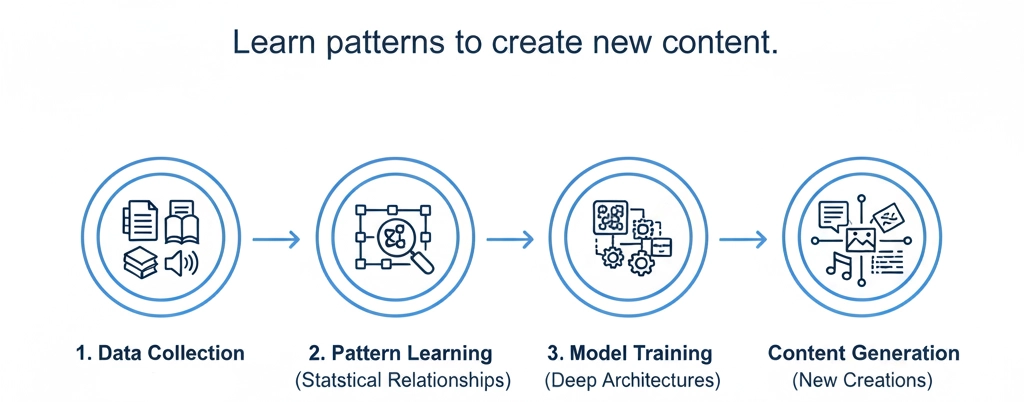
A typical application looks like this:
- Data Collection: The model is trained on large datasets containing examples such as books, articles, images, videos, or collections of code.
- Pattern Reading: The algorithm learns mathematical relationships within the data, such as how words go together in a language or how pixels fit together to form objects in images.
- Model Training: Deep learning structures such as transformers, distribution models, or generative adversarial networks are trained to capture these patterns.
- Content generation: Once trained, the model can generate new outputs such as text paragraphs, images from notifications, audio clips, or code snippets.
The core purpose is clear: Generative AI models learn patterns in data so they can create new content that follows those patterns.
Similarities and Differences
Both Agent AI and Generative AI are part of the AI ecosystem:
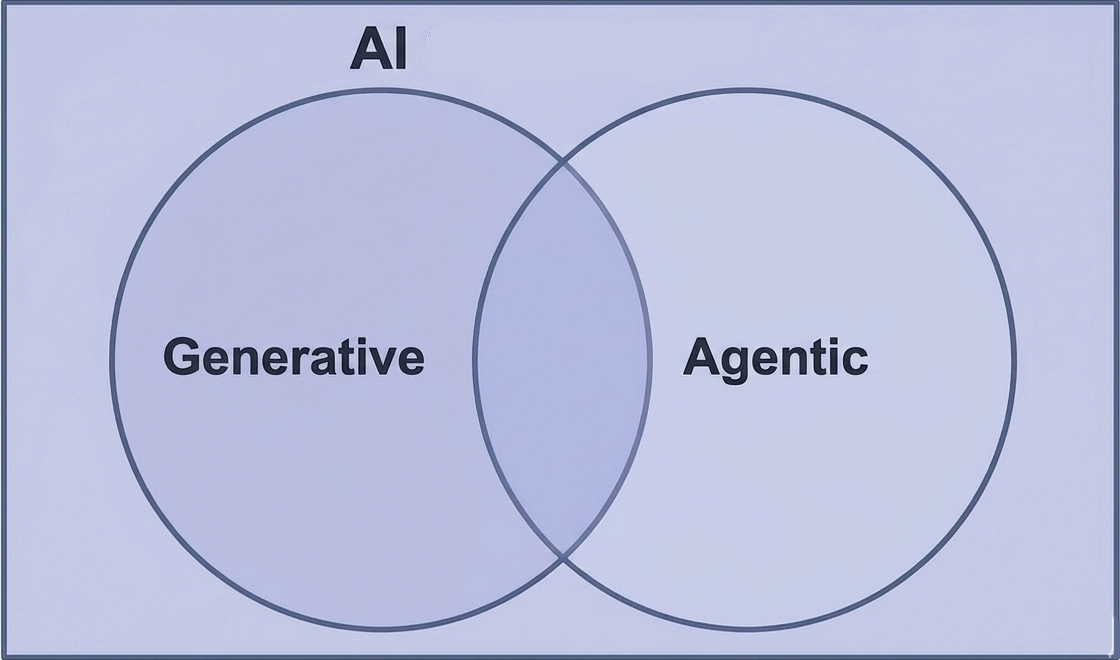
This means that both types of AI share some qualities with each other, but also differ in other aspects. All while being part of the AI ecosystem.
Here are the key differences between generative AI and agent AI:
| A feature | Generative AI | AI Agent |
| Functional Logic | Linear (Note → Feedback) | Iteration (Goal → Plan → Action → Review) |
| Independence | Down (Requires constant human supervision) | Advanced (Able to work independently for long hours) |
| The environment | Closed (Only available in chat) | Open (Works with the web, apps, and files) |
| A key metric | Content Quality / Accuracy | Objective Completion / Success Rate |
| Managing Failure | Hallucinates or gives incorrect feedback | Tries again with a different strategy (Self-correction) |
Why the World Goes to Agents
Generative AI is amazing, but it’s creating a “Job Gap.” When an AI writes a report, a human still has to check it, format it, and email it.
Agent AI is closing the Career Gap. The popularity of agents (such as AutoGPT, CrewAI, or Microsoft’s AutoGen) is due to the fact that they produce results, not just drafts. We are from the country where we use AI as a partner to delegate work to AI and call it a day.
The conclusion
If Artificial Intelligence is a brain, too Generative AI that’s the word AI Agent it’s the hands. Both of these domains serve a different purpose, and benefit from each other’s attributes.
Generative AI has changed the way we create, but Agentic AI will change the way we work. The future is not limited to models that can talk to us. It’s about agents who can do the work for us while we focus on other things.
Frequently Asked Questions
IA. Generative AI creates content from information, while Agentic AI automatically organizes, uses tools, and performs actions to complete complex goals.
A. Agentic AI works through a logic loop: understanding goals, planning steps, implementing tools or APIs, observing results, and iterating until the task is completed.
IA. Agent AI moves beyond content generation to task automation, allowing AI systems to complete workflows, implement tools, and achieve goals with minimal human supervision.

I specialize in reviewing and refining AI-driven research, technical documentation, and content related to emerging AI technologies. My experience includes AI model training, data analysis, and information retrieval, which allows me to create technically accurate and accessible content.
Sign in to continue reading and enjoy content curated by experts.