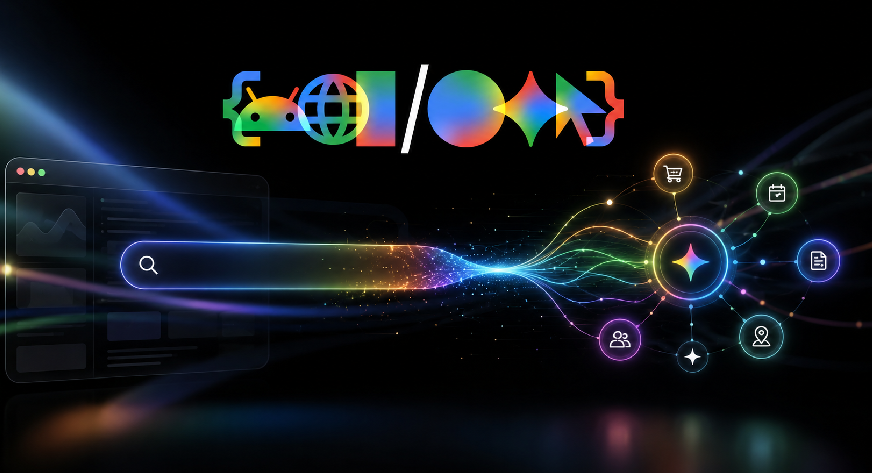
Google Search recently went from being an encyclopedia to an assistant.
That’s the gist of everything Google announced at its latest I/O 2026 conference. The buzzword is “AI agents”, now entering Google Search, its coding platforms, and even a new autonomous system. The idea is to move from AI that answers to AI that actually does things for you.
Which means – the next time you’re looking for that favorite pair of jeans or shirt online, you don’t have to sift through an endless list of websites. Just tell Google Search, and it will boil down options that match the exact jeans or shirt you chose. In the background, its AI agents will scroll through millions of websites in seconds and try to find the closest match possible. Before, you wait for a few seconds and get the option to buy in front of you.
You don’t need me to tell you this – it’s a revolutionary change in the way we search the internet. And it comes after 25 solid years of Google Search as we know it – search and check the forum list for the right answer. With AI agents in the mix, just ask, and it will be done.
But wait, that’s one of the updates that Google introduced at Google I/O 2026. Here’s everything the top experts revealed at the event, and how it changes your life for the better/worse.
Google Search Discovers AI Agents
This is a huge highlight, just because of the scale of the impact it brings. Google Search is the go-to place on the Internet for many users around the world. And with its new and changed behavior, I am sure that this update will mark a turning point in the history of the Internet.
As I said, Google Search will now be based on making your query, instead of just answering it. So how does that change things? Well, you are reading an example of online shopping above. Here are some examples to give you a deeper context.
A Google search can now help you visualize the concepts:
Imagine you want to understand a new concept, and the visual feature will help you do that. Now, you can simply ask Google’s AI Mode to show you a visual representation of the concept, and the agent AI inside will come to it. That means, you no longer have to search through websites or watch YouTube videos to find the right visuals. Google search will help you produce what you need once, when you need it.
Now you can type in Google Search:
Have a code you need help with? Just share it with Google search and ask for help, and the built-in AI agents will get to work.
Follow events and updates with a Google search:
Now, you can ask Google Search to remind you of an upcoming event or update of your choice. Google’s AI agents will automatically create a tracker that notifies you of a Google app if and when it happens.
I hope these examples give you an idea of what Google Search knows now. Bottom line – Google Search can now help you understand, search, and act, and all you have to do is ask.
The core of it all is Google’s new AI model – Gemini 3.5 Flash. Which brings us to the next big update announced by Google at Google I/O 2026…
Gemini 3.5 Flash Is Here
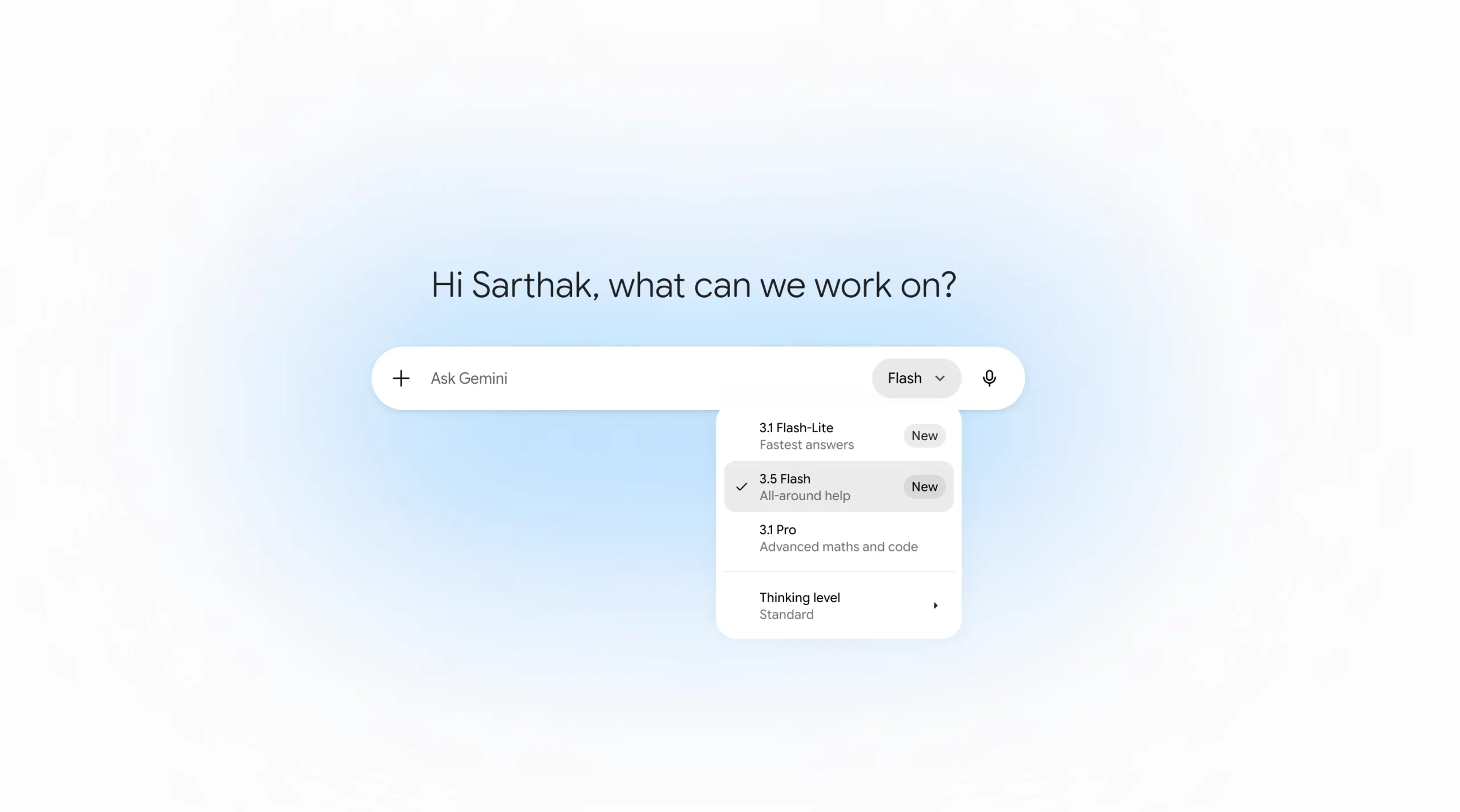
This marks the birth of a new family of AI models from the house of Google, namely Gemini 3.5. We can now see its Flash or flash version on all platforms now – including the Gemini app and Google Search. Meanwhile, the company has also planned to launch the Gemini 3.5 Pro next month. But for now, Gemini 3.5 Flash is the model that most suggests Google’s new AI. Developers can access the model through Google Antigravity, Gemini API, AI Studio, and Android Studio, while Enterprise clients can access it through Gemini Enterprise Agent Platform and Gemini Enterprise.
The important bit is simple – Gemini 3.5 Flash is designed for action. Google claims it delivers frontier-level performance to agents and code, while being 4x faster than other frontier models in issuing tokens per second. In practice, that means faster responses, better coding assistance, more powerful agent workflows, and AI-generated communications that evolve within Search itself.
Gemini 3.5 Flash Highlights
Some highlights are as follows:
- Gemini 3.5 Flash is now the default model for the Gemini app and AI Mode in Google Search worldwide. This means that most users will get the latest Google AI capabilities in a simple and fast version of its new family.
- The model is composed of agents and coding at its core. So, instead of just answering questions, it can support workflows where AI needs to think, act, generate code, and complete multi-step tasks.
- It works closely with Antigravity to handle complex workflows. This allows developers and power users to deploy multiple AI agents, manage tasks, and create more advanced AI-led systems.
- Modeling can help generate rich web communications, graphics, and actionable information. This is what makes the new Google search feel less like a list of links and more like a powerful AI workspace.
You can read more about the new Gemini 3.5 Flash here.
Gemini 3.5 Flash also powers Gemini Spark, Google’s new 24/7 AI agent. This makes it central to Google’s larger plan to build AI systems that work behind the scenes for users, and brings us to the next big update from Google I/O 2026 –
Gemini Spark is Your 24/7 Agent
If Gemini 3.5 Flash is the brain, Gemini Spark is where Google puts that brain to work. Spark is a personal AI agent within the Gemini app that can take action throughout your digital life, under your guidance. The big difference? It doesn’t need your laptop to stay on. Spark runs on dedicated virtual machines in the Google Cloud, meaning it can keep running in the background, 24/7, while you go about your day.
Powered by Gemini 3.5 and the Google Antigravity harness, Spark can handle long-running tasks, interface with Google tools, and soon work with third-party tools via MCP. You’ll be able to use it within the Gemini app, and later with email, chat, Android Halo, and Chrome. In short, Spark is Google’s clearest signal that AI agents are no longer just for developers, but for everyday users.
And in the middle of this agent AI push during Google I/O 2026 comes the next big thing from Google – an AI video maker that looks as promising as Nano Banana used to make photos.
Gemini Omni: The AI Video Generation on Steroids
Gemini Omni is Google’s new model that brings Gemini’s intuitive capabilities to video creation. In simple words, it can take inputs such as text, images, video, and audio, and convert them into a single high-quality video output. The first model in this family, the Gemini Omni Flash, now comes with the Gemini app, Google Flow, and YouTube Shortcuts.
And when you see this in action, at least in the demos shared by Google, you’ll know that it’s not just another AI video creator on the internet. The best part – it allows you to edit videos with chat. Ask it to change the scene, add an object, change the action, or change the style, and it can build on your previous command without losing the original thread. Google says that Omni also uses Gemini’s real-world experience and understanding of physics, history, science, and culture to make videos more compelling, meaningful, and consistent.
In addition – it can include a photo or its own new image inside the video. So if I were to add a planet like Saturn in the middle of a space video clip, I would use a cricket ball to give it context. Or, much easier, just tell it to insert a planet, and Gemini Omni will do it.
In short, Gemini Omni can make video creation skip the editing software and feel like directing a scene. You define what you want, refine it step by step, and let the model handle the heavy lifting. That can be a big change for creators, marketers, educators, and anyone who has ever had a vision but not the tools to bring it to life.
That’s for creators, but of course, Google I/O is all about developers, and it can’t wrap up without any developer-focused features. Here are some –
Google Updates – Everything for Developers
This year, Google’s direction is clear – it doesn’t just want developers to use AI. It wants them to build software with AI agents.
Agentic development with Antigravity
The biggest update here is Antigravity 2.0, Google’s new first agent development platform. With Antigravity and the new Antigravity CLI, developers can now create specialized subagents for complex workflows. One agent can code, one can test, one can debug, and one can handle repetitive tasks. Google also added security features like terminal sandboxing, credential hiding, and strict Git policies to keep this workflow safe.
AI Studio and Android Development
Google AI Studio has also received a major upgrade. It now supports native Kotlin, Google Workspace integration, one-click deployment to Cloud Run, Firebase support, and project deployment to Antigravity. This means developers can build, connect, deploy, and continue to develop full-stack applications in one place.
For Android, Google introduced the Android CLI, open-source Android capabilities for LLMs, Android Bench, and a migration agent within Android Studio. The migration agent is very interesting because it can help convert apps built on React Native, web frameworks, or iOS to native Kotlin Android apps.
Web Development Gets Agenttic Again
For web developers, Google introduced WebMCP, Modern Web Guidance, Chrome DevTools for agents, and HTML-in-Canvas. Together, these tools help AI agents implement web tasks, follow best practices, debug code, perform tests, and build immersive web experiences.
In short, Google is preparing developers for a world where apps, websites, and workflows are built not just by humans using AI, but by humans working with teams of specialized AI agents.
The conclusion
Google I/O 2026 made one thing abundantly clear: Google is taking the AI approach beyond the answer machine. Now build an AI that can answer your questions and get the job done. Be it Google search or its AI-powered platforms.
If things go as Google has planned, we’ll all soon be shopping, tracking updates, building gadgets, creating videos, or managing digital tasks in a new way. In time, everything will be an action engine, not a “search engine” as we know it.
Of course, there were a few other updates as well, including AI hardware, Ask YouTube, developer tools, and more. But the larger message remained the same across the board.
Google doesn’t want AI to be just another app you open. It wants AI to be the layer through which you use the Internet itself.
Sign in to continue reading and enjoy content curated by experts.