Artificial intelligence is developing rapidly. The minute we get used to one success, another comes along to change our expectations. The new model, the Claude Opus 4.7, introduced by Anthropic recently, is one such change. The rollout often goes beyond just AI chatbots and makes AI a trusted, independent digital partner. Even for developers and technicians, this update will be of great benefit for advanced software engineering and complex problem solving.
Just why, and what is different about the new Claude Opus 4.7? That’s what we’re here to find out.
Claude Opus 4.7 vs Opus 4.6: What’s New
First things first, the Opus 4.7 is not an easy tune. The latest Anthropic model is dedicated to cross-border operations. This means that it deals with tasks that previously had to be under human supervision. Development is evident in all these broad areas.
Advanced Software Engineering
Opus 4.7 is now able to support long-term, complex code projects. It is not a line-by-line code generator but is designed for “harder tasks.” Because of this, Anthropic says users have reported a lower steering requirement in Opus 4.7 over Opus 4.6, even for their most demanding coding work.
There are three main advantages here that make Opus 4.7 better than its outgoing counterpart. First, it handles complex tasks that take time “with firmness and consistency.” Which means you can lean and rely on the model to get a more accurate result.
It also pays close attention to the instructions given for any task, meaning you can be sure Opus 4.7 is following your own set of guidelines. Third and most important, Opus 4.7 finds ways to validate output before reporting. Now that’s an extra layer that wasn’t there with Opus 4.6
Better Vision
Opus 4.7 also promises a much better vision than Opus 4.6. This means that Claude’s new model can see images with greater resolution. In numbers, this comes to 2,576 pixels on the long edge, or about 3.75 megapixels. Note that this is over three times more megapixels than Claude’s previous models.
So what does this mean? Imagine data extraction from dense screenshots and complex diagrams, and such professional work with high precision.
Advanced Real World Work
In Anthropic’s internal testing, it found the Opus 4.7 to be significantly better than the Opus 4.6 in almost all areas of real-world tasks. For example, it proved to be a better financial analyst, “producing robust analyzes and models, professional presentations, and tight integration across operations.”
Also in third-party testing, Opus 4.7 outperformed version 4.6 in performing economic value information work. This development has been seen in all fields such as finance, law, and other fields.
Memory
Anthropic says its latest model is better at using file system-based memory. This means that Opus 4.7 is able to recall important notes throughout a “long, multi-session work.” Needless to say, this has its importance any time you plan to start a new job. Because with such a memory, you need less prior context whenever you direct the AI model to a new task.
Claude Opus 4.7: Technical Features
These new capabilities in Opus 4.7 are driven by many technical improvements. These structures give engineers more work and expand the model’s sensor inputs.
- High Resolution Vision: A significant upgrade, the Claude Opus 4.7 is the first Claude model capable of supporting high definition vision. It has the ability to process images up to 2576 pixels on the long side. This enables it to interpret complex technical diagrams, dense spreadsheets, and financial graphs with great accuracy.
- Maximum Effort Level: A new API setting allows users to select a “high” level of thinking to go to maximum effort. This provides better control of the balance between depth and speed of response in complex tasks.
- Claude’s Code Development: The new /ultrareview slash command generates a special review session that reads changes and identifies bugs and design issues that a careful reviewer might not see. Pro and Max Claude Code users get three free reviews to try. In addition, an automatic mode has been added for advanced users. Automatic mode is a new feature of permissions where Claude decides on your behalf. This means you can run longer processes with fewer interruptions and with less risk than you would when permissions are disabled.
- Improved Tokeniser: The new Anthropic model has an improved text processing token. While this has the potential to make token usage slower, Anthropic claims it improves overall performance.
- Project Budgets: Developers building agent workflows can now establish a token limit on the amount of money spent on long-running tasks with this beta feature. This helps the AI to focus on its work effectively without incurring unexpected costs.
Claude Opus 4.7: Benchmark Performance
Claude Opus 4.7 looks very strong when real-world agent work starts to matter. It posts 64.3% in SWE-bench Pro and 87.6% in SWE-bench Verified, putting it ahead of GPT-5.4, Gemini 3.1 Pro, and Opus 4.6 in software engineering tasks on this chart. It also performs well in Terminal-Bench 2.0 at 69.4%, suggesting strong performance in end-to-end coding-based workflows, although GPT-5.4 is shown to be higher at 75.1% under the self-reported harness. Aside from coding, Opus 4.7 remains competitive in all heavy tasks as well, scoring 94.2% in GPQA Diamond, 91.5% in MMMU for multilingual Q&A, and 82.1% / 91.0% in CharXiv’s visual reasoning and tools, respectively. In simple words, this model is not only good for conversational style thinking, but also reliable for all code, idea, search, and evaluation research method.
That said, the chart also shows where Opus 4.7 is not completely dominant. GPT-5.4 leads BrowseComp at 89.3%, so Claude is not the top pick here in the agent search. In the Ultimate Human test, Opus 4.7 performs solidly at 46.9% without tools and 54.7% with tools, but Mythos Preview and GPT-5.4 score higher. So the broad takeaway is clear: Claude Opus 4.7 looks like a very powerful all-rounder with some strengths in coding and workflow tools, even if it’s not a chart leader in every single benchmark.
Safety First: Project Glasswing and Cyber Safeguards
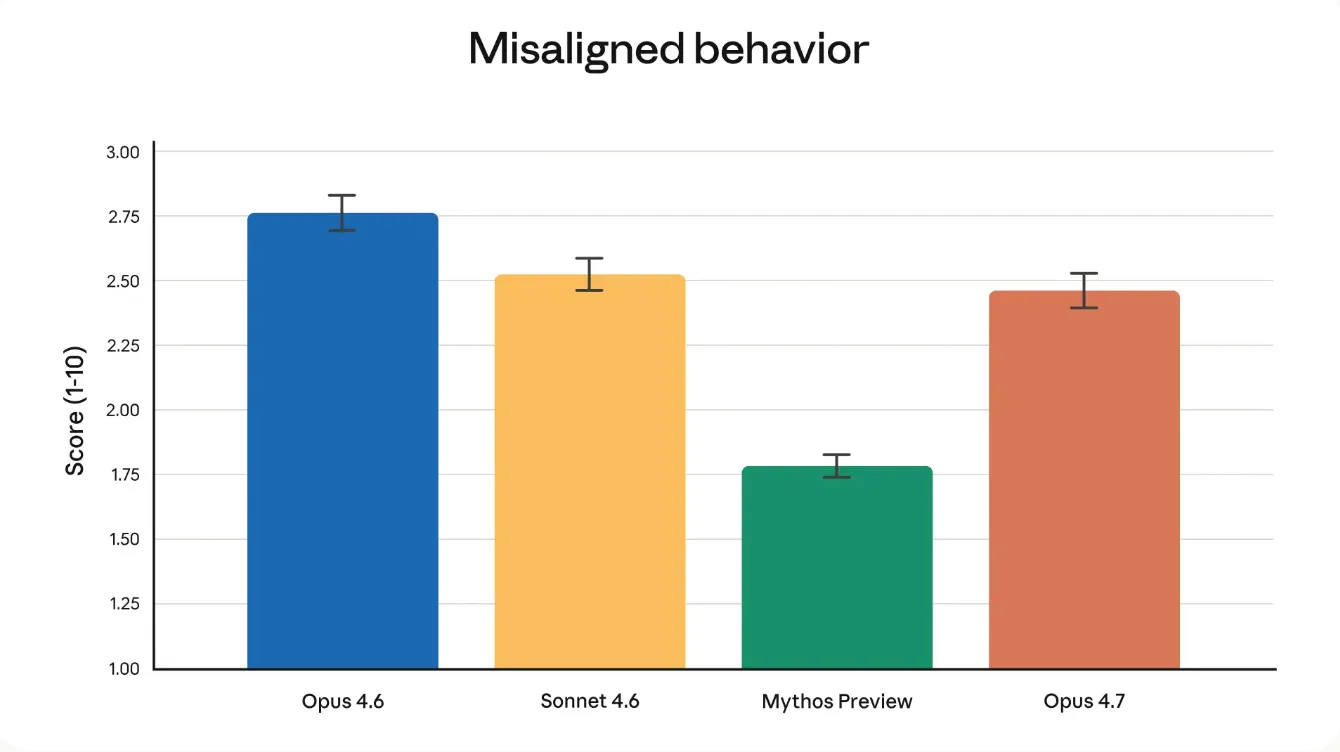
With great power comes great responsibility. Anthropic’s new model was introduced as part of a security project, called Project Glasswing. The project ensures that AI as powerful as this model is built and used conscientiously.
The first model that provides high-risk cybersecurity request detection is Opus 4.7, which detects hacking or vulnerability analysis requests. Anthropic also introduced a Cyber Assurance Program. Under this program, legitimate security professionals have access to the full capabilities of this model in a defensive manner. This is a reflection of security as a basic feature and not an add-on.
Claude Opus 4.7: Availability and Pricing
The model can be accessed on all common platforms:
- Fields: Claude.ai, Claude API, Amazon Bedrock, Google Cloud Vertex AI, Microsoft Foundry, and GitHub Copilot.
- Price: Same price as Opus 4.6 (5/ million input tokens / 25/ million output tokens).[2]
- Preparation: Optimization is supported at launch: Fast caching (up to 90% savings) and batch processing (50% savings).
Go with Claude Opus 4.7
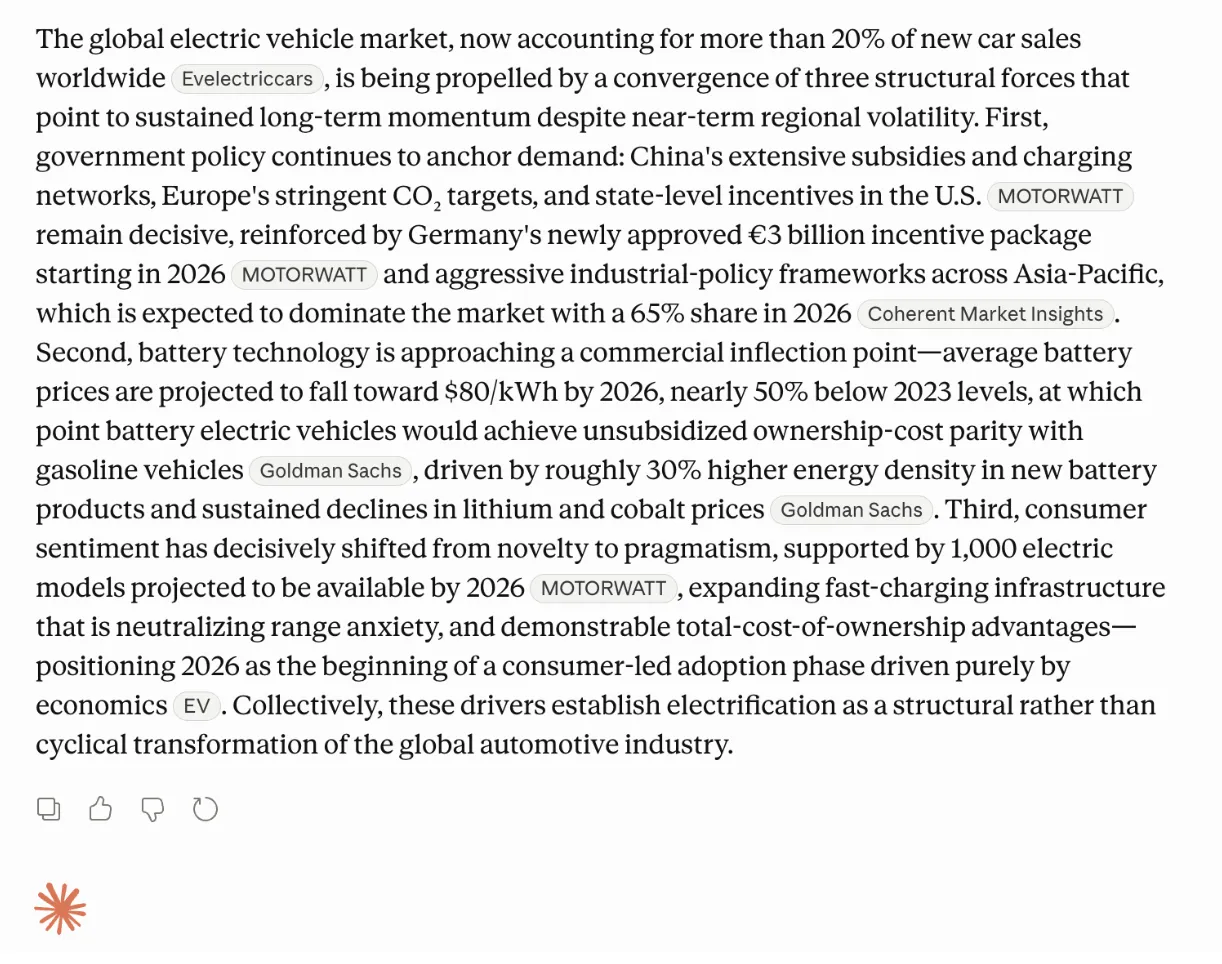
Let’s see the model in action. Here are two examples of how you can use its new capabilities.
1. Chatbot Example: Market Research Analyst
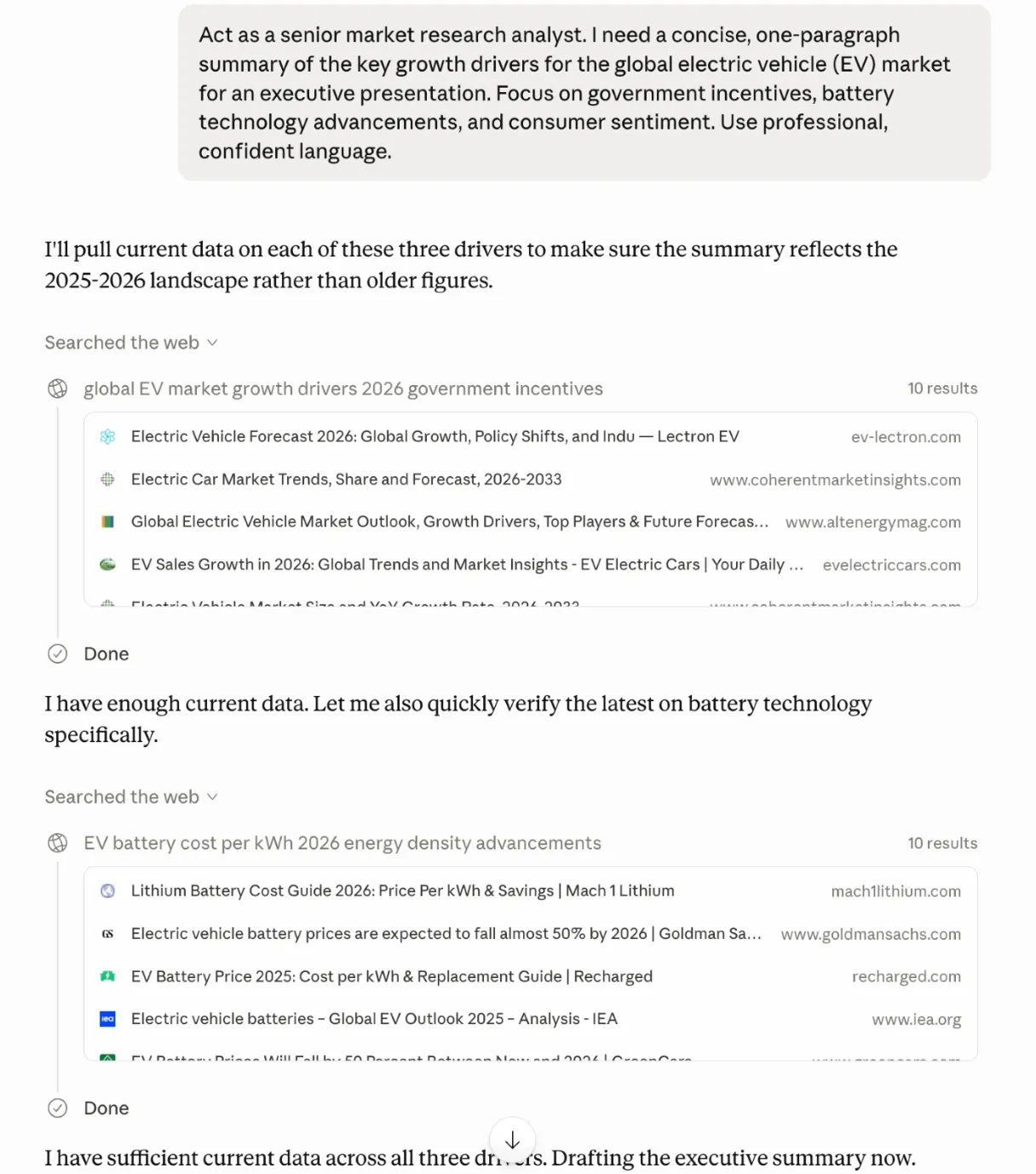
Imagine you need a quick analysis of a new market trend. You can assign Claude Opus 4.7 a role.
Notify:
Act as a senior market research analyst. I need a short, one-section summary of the key steps in the growth of the global electric vehicle (EV) market to make an executive presentation. Focus on government benefits, battery technology development, and consumer sentiment. Use professional, confident language.
Output:
2. Code Example: Building a Web Application with Claude’s Code
Here, we will ask the model to perform an advanced software engineering task: to create a simple yet complete web application.
Notify:
Create one HTML file for the “Project Time Tracker” web application. Use vanilla JavaScript and basic CSS. The application must be:
- Project name input field.
- “Start Time” button that records the start time.
- A “Stop Time” button that calculates and displays the elapsed time for that project.
- A list below the controls where each completed project and its duration is displayed.
Output:
The code is clean, efficient, and well-structured, demonstrating the model’s ability to handle complex, multi-part work efficiently. The output is small, efficient, and simply perfect.
The conclusion
Claude Opus 4.7 is not an incremental update. It’s a bold step toward a more specialized, autonomous AI that professionals can trust. The new Anthropic model is made to work with its advanced coding, precision in following instructions, and strong vision. Emphasizing security and control helps users gain confidence in deploying complex systems. With the continuous development of AI, such models will not be used as tools but as a necessary part of the team.
Frequently Asked Questions
Yes, it is immediately available on Claude.ai, the Claude API, and cloud partners such as Amazon Bedrock and Google Cloud Vertex AI.
No, the price remains the same as Opus 4.6. However, a new token may cause a slight increase in the number of tokens for the same input.
It allows the model to accurately read and interpret dense visual information such as technical drawings, financial reports, and detailed user communications.
It has built-in detectors to block the most dangerous cybersecurity applications and offers a system to certify legitimate security professionals to use their skills defensively.
It’s a good idea to update them. The model is very realistic, so you must ensure that your instructions are clear and concise to get the best results.
Sign in to continue reading and enjoy content curated by experts.