The 2-Minute Rule: How This Simple Habit Can Help You Finish More Tasks

The 2-Minute Rule: How This Simple Habit Can Help You Finish More Tasks
Small tasks can easily pile up during a busy day. A quick email becomes an unfinished message, a document sits waiting to be organized, and a simple household task gets postponed until tomorrow.
One simple productivity technique can help you deal with these small tasks before they become a long to-do list: the 2-minute rule.
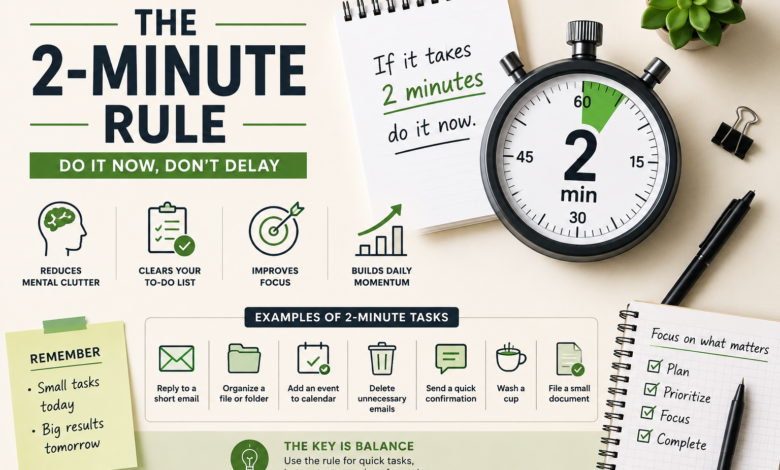
The idea is simple: if a task can be completed in about two minutes, do it immediately instead of adding it to your task list.
This approach can help reduce mental clutter and make your daily workload feel more manageable.
What Is the 2-Minute Rule?
The 2-minute rule is a productivity technique popularized by productivity author David Allen as part of the Getting Things Done methodology.
The basic principle is straightforward:
If you can complete an action in roughly two minutes, handle it now.
For example, instead of adding “reply to this simple email” to your task list, you can respond immediately.
Other examples include:
- Putting a document in the correct folder
- Replying to a short message
- Adding an appointment to your calendar
- Washing a cup
- Filing a small document
- Sending a quick confirmation
- Deleting unnecessary emails
The goal is to prevent tiny tasks from creating unnecessary mental and organizational overhead.
Why Does the 2-Minute Rule Work?
Small unfinished tasks can take up mental space.
Even when a task only requires a few minutes, remembering that you still need to complete it can create additional cognitive load.
Completing small tasks immediately can provide several benefits:
- Fewer small tasks on your to-do list
- Less mental clutter
- Faster decision-making
- A cleaner workspace
- A greater sense of progress
However, the rule works best when you use it selectively.
1. Use It for Quick Emails
Email is a perfect example.
Suppose someone sends you a message asking a simple question that you can answer immediately. Instead of marking it for later, reply if the response genuinely takes only a couple of minutes.
This prevents simple messages from accumulating in your inbox.
For longer emails, don’t force yourself to finish them immediately. Add them to your task system and handle them during a dedicated email session.
2. Use It for Small Digital Tasks
Many computer tasks take only a few minutes.
For example:
- Renaming a file
- Moving a document
- Updating a calendar entry
- Saving important information
- Sending a short client confirmation
- Organizing a few files
If the task is genuinely quick and doesn’t interrupt important focused work, completing it immediately can be efficient.
3. Use It Around Your Workspace
The rule isn’t limited to digital work.
You can use it for small physical tasks too.
If something takes about two minutes, handle it instead of letting it accumulate.
Examples include:
- Putting equipment away
- Throwing away unnecessary papers
- Cleaning your desk
- Refilling water
- Organizing a small group of items
A cleaner environment can make it easier to focus on larger tasks.
4. Don’t Let the Rule Interrupt Deep Work
The 2-minute rule has an important limitation.
If you’re working on something that requires deep concentration, immediately responding to every small task can actually reduce productivity.
For example, imagine you’re writing an important article and receive a notification about a two-minute task.
Stopping your writing may break your concentration and require several minutes to regain focus.
In this situation, it can be better to ignore the task temporarily and finish your focused work.
The 2-minute rule should support your productivity, not constantly interrupt it.
5. Combine It With a To-Do List
A to-do list and the 2-minute rule can work together.
When a new task appears, ask:
Can I finish this in about two minutes?
If yes, complete it immediately when doing so won’t interrupt important work.
If no, add it to your task list and decide when you’ll handle it.
This simple decision can prevent your task list from becoming unnecessarily long.
6. Use It to Reduce Email Clutter
An overloaded inbox can make it difficult to identify important messages.
When checking email, you can quickly process simple messages:
Read → Decide → Respond or organize
For messages requiring significant research or a detailed response, schedule them for later.
This keeps quick communications from becoming unnecessary backlog.
7. Apply It to Your Daily Routine
The rule becomes more useful when you make it part of your normal workflow.
For example:
Morning: Quickly handle simple administrative tasks.
Work session: Focus on important projects without interruptions.
Afternoon: Process email and smaller tasks.
Evening: Organize your workspace and prepare for tomorrow.
This creates clear periods for both quick tasks and deep work.
Common Mistakes With the 2-Minute Rule
Although the rule is simple, it’s easy to misuse.
Mistake 1: Treating Every Task as Urgent
Not every small task needs to be completed immediately.
Some tasks can wait.
Mistake 2: Constantly Checking Notifications
If you keep checking messages just because they might contain two-minute tasks, the rule can become a source of distraction.
Mistake 3: Starting Large Tasks
A task may look small but actually require much more time.
If something takes 15 or 20 minutes, don’t force it into the 2-minute category.
Mistake 4: Interrupting Important Work
If you’re in the middle of focused work, save non-urgent small tasks for later.
How to Start Using the 2-Minute Rule Today
You don’t need special software or complicated systems.
Try this simple process:
- Choose one period during the day to test the technique.
- When a small task appears, estimate how long it will take.
- If it’s genuinely around two minutes and won’t interrupt important work, complete it.
- If it’s longer, add it to your task list.
- Review your results at the end of the day.
After a few days, you’ll learn which types of tasks are worth handling immediately and which should be scheduled.
Final Thoughts
The 2-minute rule for productivity is a simple technique, but it can be surprisingly useful for managing small tasks.
By completing quick actions instead of constantly postponing them, you can reduce clutter and keep your task list focused on work that actually requires your attention.
The key is balance. Don’t interrupt deep work for every tiny task. Use the rule when it genuinely saves time, and schedule larger tasks for dedicated periods.
A simple habit practiced consistently can make your daily workflow feel much more organized.