Topical Authority SEO: How to Build a Powerful Website in 2026
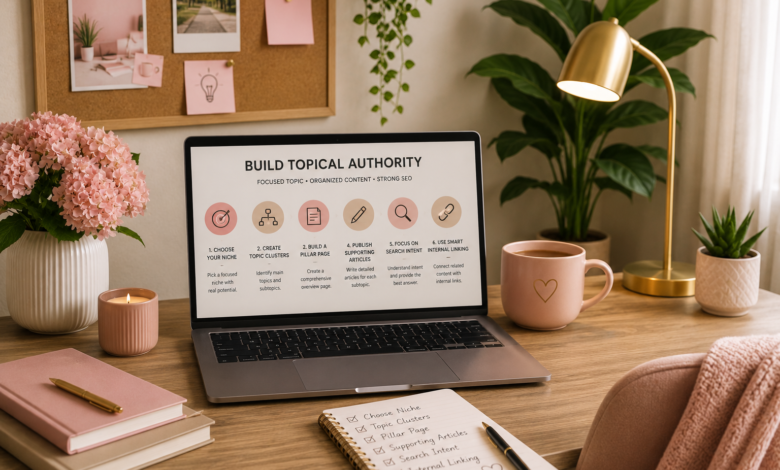
Building a successful blog is no longer just about publishing hundreds of random articles. In 2026, a stronger approach is to build topical authority by creating comprehensive content around a specific subject and showing search engines that your website consistently covers that topic.
A topical authority website can attract organic traffic, improve internal linking, build reader trust, and create more opportunities for monetization.
In this guide, you’ll learn how to build a topical authority website from scratch.
What Is Topical Authority in SEO?
Topical authority means that a website has strong, relevant coverage of a particular subject.
For example, instead of creating a general website about everything related to the internet, you could build a website specifically about SEO and blogging.
You might cover:
- SEO basics
- Keyword research
- On-page SEO
- Technical SEO
- Content marketing
- Internal linking
- Blogging strategies
- Google Search Console
- Link building
- Website speed
- SEO tools
- AI and SEO
When these topics are connected through useful content and internal links, your website can demonstrate strong topical relevance.
Step 1: Choose a Focused Niche
The first step is choosing a clear niche.
Avoid starting with a topic that is extremely broad unless you have the resources to cover it thoroughly.
For example:
Too broad:
- Technology
More focused:
- AI tools for small businesses
Too broad:
- Finance
More focused:
- Personal finance for young professionals
Too broad:
- Health
More focused:
- Healthy meal planning for busy families
A focused niche makes it easier to create related content and develop topical depth.
Step 2: Create Main Topic Clusters
After selecting your niche, identify the major subjects your audience needs to understand.
These become your content clusters.
For an SEO blog, your clusters could include:
Keyword Research
Articles might cover:
- How to find low-competition keywords
- Long-tail keywords for beginners
- Search intent explained
- Keyword research mistakes
- How to find keywords without expensive tools
On-Page SEO
You could publish:
- How to optimize title tags
- How to write SEO-friendly headings
- Meta descriptions explained
- Image SEO tips
- Internal linking strategies
Technical SEO
Possible articles include:
- XML sitemap guide
- Robots.txt explained
- Core Web Vitals
- Mobile SEO
- Website indexing problems
Each cluster should contain multiple useful articles connected to the same subject.
Step 3: Build a Pillar Page
A pillar page is a comprehensive article covering a broad topic within your niche.
For example:
SEO for Beginners: The Complete Guide
This page could introduce:
- Keyword research
- Search intent
- On-page SEO
- Technical SEO
- Internal linking
- Content optimization
- Link building
- SEO measurement
You can then create separate detailed articles about each subtopic and link them back to the pillar page.
This creates a logical content structure.
Step 4: Publish Supporting Articles
Your pillar page shouldn’t be your only article.
Create supporting content that answers specific questions.
For example, if your pillar topic is Keyword Research, supporting articles could include:
- How to Find Low-Competition Keywords
- What Are Long-Tail Keywords?
- How to Identify Search Intent
- How Many Keywords Should You Target in One Article?
- Common Keyword Research Mistakes
- How to Find Question-Based Keywords
These articles allow you to cover the subject from different angles.
Step 5: Focus on Search Intent
Ranking isn’t only about including keywords.
You need to understand what the searcher actually wants.
For example, someone searching:
“What is internal linking?”
probably wants an explanation.
Someone searching:
“best internal linking tools”
is likely comparing tools.
Someone searching:
“how to add internal links in WordPress”
wants a practical tutorial.
Your content should match the intent behind the search query.
Before writing an article, ask:
“What problem is the searcher trying to solve?”
Then make your article the most useful answer you can provide.
Step 6: Use Smart Internal Linking
Internal links are extremely important when building topical authority.
Whenever you publish a new article, look for relevant older articles that you can link to.
For example:
Pillar Page → Supporting Article
and
Supporting Article → Related Supporting Article
You might have:
SEO Guide
↓
Keyword Research Guide
↓
Low-Competition Keyword Guide
↓
Long-Tail Keyword Guide
This creates a connected content ecosystem instead of a collection of unrelated blog posts.
Step 7: Cover Topics Completely
Don’t stop after publishing one article about a subject.
Look for related questions, subtopics, examples, problems, comparisons, and practical guides.
For example, if your website focuses on blogging, you could cover:
- Starting a blog
- Choosing a niche
- Domain names
- Web hosting
- WordPress
- Keyword research
- Content writing
- SEO
- Internal linking
- Google Search Console
- Website monetization
- Affiliate marketing
- Email marketing
The goal is to become a genuinely useful resource within your chosen area.
Step 8: Prioritize Quality Over Quantity
Publishing 20 excellent articles can be more valuable than publishing 200 weak articles.
Every article should provide something useful.
Before publishing, check:
- Does the article answer the main question?
- Is the information easy to understand?
- Are examples included where useful?
- Are headings organized logically?
- Are relevant internal links included?
- Is the article original and helpful?
- Does the introduction quickly address the reader’s problem?
- Are unnecessary sections removed?
Avoid creating content simply because you found a keyword.
Step 9: Update Your Existing Content
Topical authority isn’t something you build once and forget.
Review older content regularly.
Update articles when:
- Information becomes outdated
- Search intent changes
- New developments affect the topic
- Better examples become available
- You publish related articles
- Internal linking opportunities increase
Updating useful existing content can also help keep your website relevant to readers.
Step 10: Track Your SEO Performance
Use analytics and search data to understand what is working.
Monitor:
- Organic clicks
- Search impressions
- Ranking keywords
- Click-through rate
- Indexed pages
- Top-performing articles
- Pages losing traffic
- Internal linking opportunities
Don’t become obsessed with rankings immediately after publishing.
New websites often need time to establish visibility and authority.
A Simple Topical Authority Strategy
If you’re starting a new SEO and blogging website, you could use this structure:
Main Topic: SEO
Cluster 1: Keyword Research
10–15 articles
Cluster 2: On-Page SEO
10–15 articles
Cluster 3: Technical SEO
10–15 articles
Cluster 4: Content Strategy
10–15 articles
Cluster 5: Link Building
10–15 articles
Cluster 6: Blogging
10–15 articles
Instead of publishing these randomly, organize them into logical clusters and connect related articles with internal links.
Common Topical Authority Mistakes
1. Choosing Too Many Niches
A website about SEO, recipes, cryptocurrency, travel, sports, and technology may become difficult to organize.
Start with a clear focus.
2. Publishing Random Keywords
Don’t build your content strategy around disconnected keywords.
Think in terms of topics and relationships between articles.
3. Ignoring Search Intent
An article can target the right keyword but still perform poorly if it doesn’t satisfy the searcher’s actual goal.
4. Creating Thin Content
Don’t write short articles just to increase your published-post count.
Focus on usefulness and completeness.
5. Forgetting Internal Links
Even excellent articles can become isolated if you don’t connect them to related content.
6. Chasing Traffic Only
A high-traffic keyword isn’t always the best choice.
A smaller keyword that attracts highly relevant visitors can be more valuable for your website.
How Long Does It Take to Build Topical Authority?
There is no fixed timeline.
A new website may need months to develop meaningful organic visibility, depending on factors such as competition, content quality, website history, technical SEO, links, and how well the content satisfies users.
Instead of expecting instant results, focus on building a strong content library consistently.
Final Thoughts
Building a topical authority website in 2026 requires more than publishing articles around random keywords. The better strategy is to choose a focused niche, organize content into topic clusters, create comprehensive pillar pages, publish helpful supporting articles, and connect everything through smart internal linking.
Most importantly, create content for people first.
If your website consistently provides useful answers across an entire subject, you’ll have a much stronger foundation for long-term organic search growth.